
A shared context shaped by climate and seasons
What makes nature-based solutions (NbS) distinctly Nordic are not the measures themselves, but the conditions they operate within. Across the region, long winters with limited daylight, snow management, road salting, and low sun angles shape how landscapes function and how public spaces are used.
Seasonality as a design condition
At the first Nordlocal workshop with our municipality network the project partners met with representatives from Århus and Kolding in Denmark, Ålesund, Oslo, Halden and Sorø in Norway, Falkenberg in Sweden, Tvøroyri in the Faroe Islands, Reykjavik Iceland the region of Åland to discuss challenges and experiences working with NbS locally. It soon became clear that these seasonal dynamics are not peripheral, but actually central design conditions. In Reykjavik, for example, discussions highlighted the balance between shade and access to light, while other municipalities pointed to the impacts of snow and ice clearance on vegetation and soil.
Context matters
This means that NbS in the Nordic region must perform year-round. Solutions cannot be imported directly from other climates; they must be adapted to local environmental and social conditions.

In the Nordic countries, commuting by bicycle is common even in winter, but snow clearing is of course necessary to make this possible
Common challenges across municipalities
Despite different local contexts, many challenges are shared. At the workshop, municipalities repeatedly pointed to limited space in dense urban areas, difficulties in cross-sector collaboration, and unclear responsibility for financing and long-term management.
One planner captured this tension succinctly by stating “we are not agreeing about the trees”, illustrating how differing priorities within municipal organisations can slow down implementation.
Financial structures and availability of funds also remain a barrier. Funding can be available for establishing NbS, but much harder to secure for long-term maintenance. At the same time, competing land-use priorities and the need to demonstrate economic value make it difficult to prioritise green infrastructure in planning processes.
Maintenance as a defining factor
A recurring theme throughout the workshop was the importance, and undervaluation, of maintenance. Without long-term care, even well-designed solutions risk losing their function over time.
The idea that ‘maintenance is like a dance between object and maintainer’, as described by sociologists Jérôme Denis and David Pontille in The Care of Things: Ethics and Politics of Maintenance, captures an important aspect of nature-based solutions not as static interventions, but evolving systems that require continuous attention and adaptation.
Several municipalities, such as Halden and the region of Åland, emphasised the need for better strategies and structures for maintaining trees and green infrastructure, particularly under conditions of limited resources.
Urban and rural realities
The workshop also highlighted clear differences between urban and rural contexts. In dense cities like Århus and Kolding, the challenge is often how to make space for NbS at all. In more rural contexts, such as Tvøroyri in the Faroe Islands, issues include grazing pressure, invasive species, and landscape management.
This reinforces a key point, Nordic municipalities operate across diverse landscapes, and NbS must respond to both urban density and rural complexity within the same governance structures.
From pilots to scale – insights from the Nordic Council of Ministers
A recurring question in the Nordic work on nature-based solutions is how municipalities can move beyond pilot projects and support implementation at scale. Based on insights from the Nordic Nature Programme and previous programme reports, Lisa R. í Dali, Coordinator of the Nordic Nature Programme, notes:
“The Nordic work shows that there is already a strong knowledge base and many good examples of nature-based solutions. However, municipalities may still face limitations related to capacity, financing, governance and cross-sector coordination. These challenges show why it is important to make nature-based solutions part of existing planning and decision-making, rather than treating them as separate or additional projects. If they are to be implemented more widely, the knowledge and experience that already exist must be made easier to use in practice. This is key if nature-based solutions are to support biodiversity, climate adaptation and broader societal goals.”

Lisa R. í Dali, Coordinator of the Nordic Nature Programme
Support structures at the Nordic level play an important role in addressing these challenges:
“The Nordic Council of Ministers supports implementation by strengthening Nordic cooperation and the knowledge base on nature-based solutions. The Nordic Nature Programme works to scale up existing solutions based on nature-based methods in the Nordic region, improve networks and platforms where actors can share knowledge and experiences, and integrate nature-based solutions into climate management and nature conservation. The programme also contributes to knowledge-sharing and the integration of nature considerations into decision-making processes and activities at local, regional and national level.”
From a faroese perspective, Lisa also highlights the importance of local adaptation across Nordic context:
“Nature-based solutions need to be adapted to specific landscapes and contexts, governance structures, and local capacities. At the same time, even small-scale initiatives can serve as strong demonstration projects with the potential to inspire and be scaled in other Nordic contexts.”

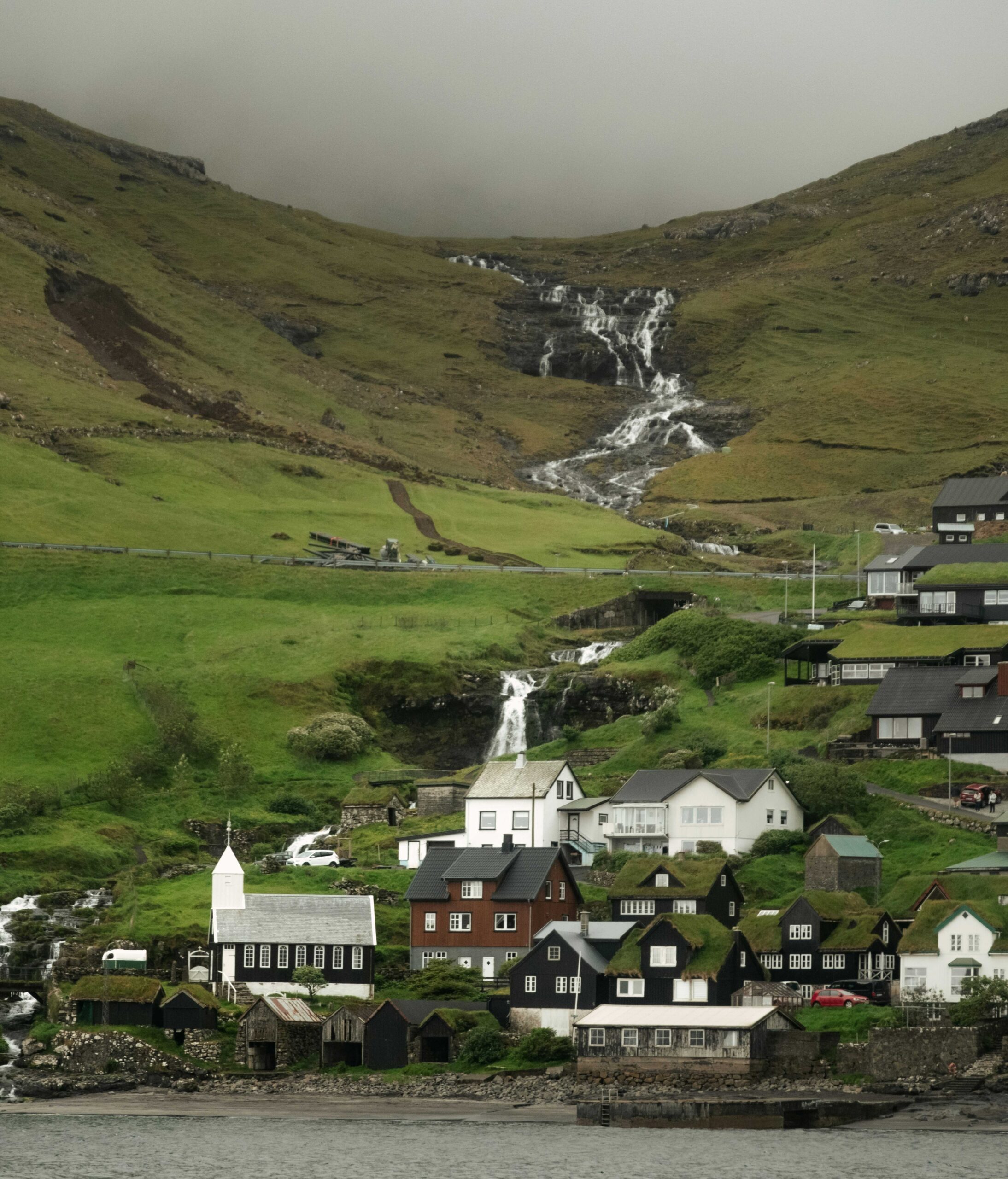
Traditional turf-roofed houses in the Faroe Islands demonstrate how green roofs—rooted in local building practices—function as nature-based solutions, enhancing insulation, managing rainwater, and blending human settlements seamlessly into the surrounding landscape.
Not copying, but translating: lessons from Yggdrasil to Nordlocal
Building on insights from the past Nordic project Yggdrasil – The Living Nordic City, a key takeaway is that scaling nature-based solutions in a Nordic context is not about replication, but rather about translation and adaptation. Solutions need to be understood in relation to place, its climate, culture, and patterns of use, and adapted accordingly. Nordlocal builds on this by focusing on exchange between municipalities, not to copy solutions, but to understand what works and how it can be adjusted to new contexts. Throughout the municipal workshop held by Nordlocal, a clear pattern emerged: the Nordic approach is defined less by specific techniques and more by a way of working long-term, place-based, and collaborative. From daylighting streams in Ålesund to expanding canopy cover in Kolding and managing water and landscapes in Reykjavik, municipalities operate under different conditions but move towards similar goals.
 Stockholm
Här är våra tvärvetenskapliga tjänster
Med vidgade vyer, transparens och ett holistiskt tänkande driver vi projekt som skapar miljönytta för både kund och samhälle. I vår tvärvetenskapliga och omfångsrika tjänstepalett finns de evidensbaserade möjligheterna och lösningsfokuserade konsulterna.


