
Making the Case for Nature-Based Solutions: Why Economic Valuation Matters
One of the biggest challenges facing municipalities today is not understanding the value of nature-based solutions. Or even more, it is making that value count in decision-making.
How can investments in wetlands, urban forests, or green infrastructure compete with roads, housing developments, or technical infrastructure when budgets are tight? How can long-term environmental and social benefits be communicated in ways that support implementation rather than remaining ambitious policy goals?
These are some of the questions being explored in the Nordlocal project funded by the Nordic Council of Ministers. Within the project, the Natural Resources Institute Finland (Luke) leads the work on economic valuation of nature-based solutions, bringing together research on how economic evidence can support better local decision-making.
Contributing research
Among the researchers contributing to this work are Professor Liisa Tyrväinen, an internationally recognised expert on ecosystem services and the economic value of urban green spaces, and doctoral researcher Leo Raivonen, whose research focuses on the economic valuation of wetland restoration. Together with colleagues at Luke, they are reviewing current research, identifying knowledge gaps, and exploring how economic valuation can become a practical tool for municipalities across the Nordic region.
At the European Forum on Urban Forestry (EFUF) in Malmö in May of this year, Liisa Tyrväinen presented some of the latest evidence on the economic benefits of nature-based solutions. Her presentation carried an important message: economic valuation is not about putting a price on nature. It is about making nature’s benefits visible in decisions where they have traditionally been overlooked.
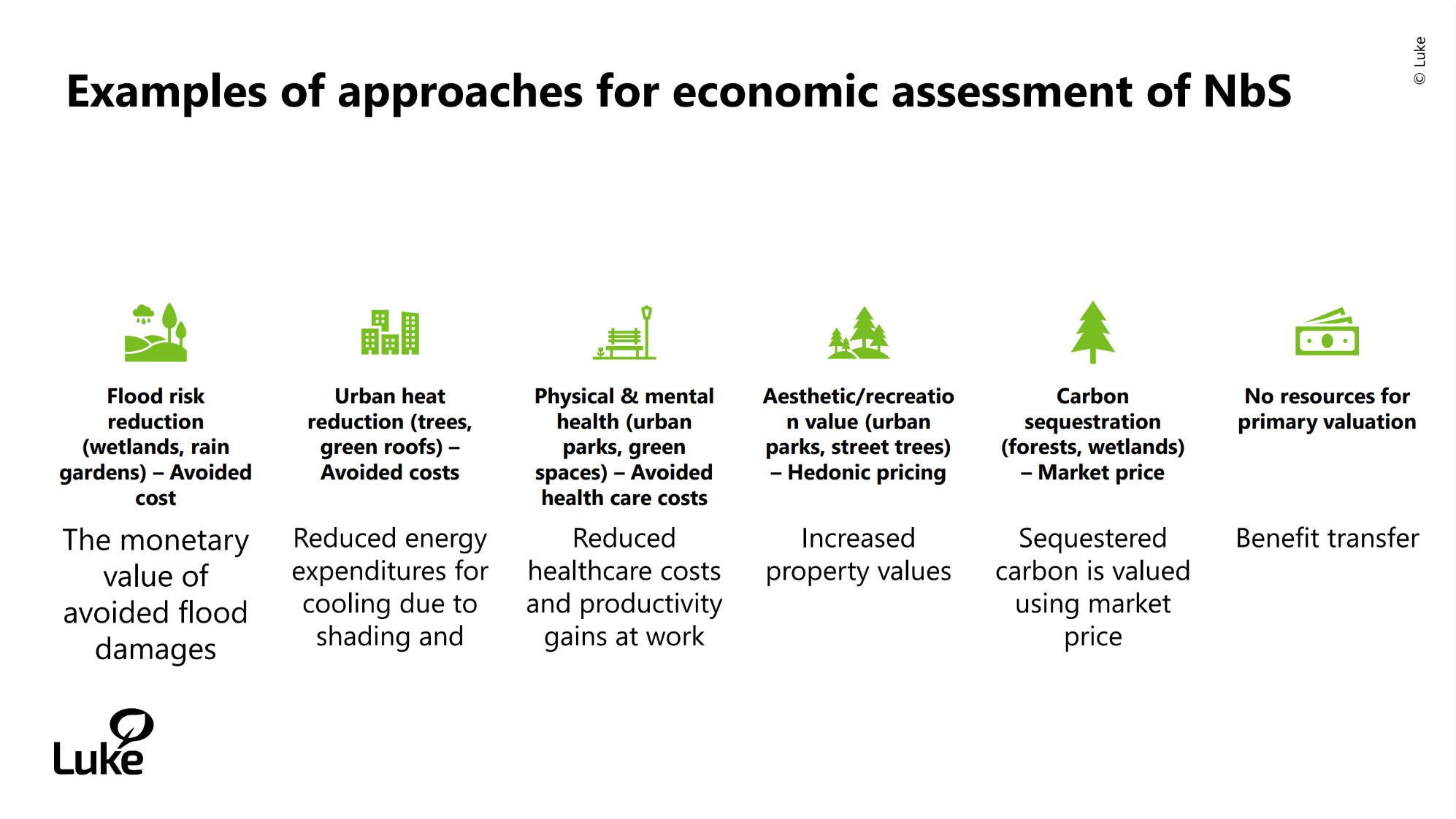
Economic valuation does not rely on a single method. Different ecosystem services require different approaches depending on the type of benefit being assessed. (Source: Liisa Tyrväinen, EFUF 2026)
Why economic valuation?
Municipal planners rarely question whether nature creates value. The challenge is that many of its benefits are difficult to measure and compare with conventional infrastructure investments.
Flood protection, cleaner water, improved public health, increased biodiversity and better recreational opportunities often fall under different municipal departments, making it difficult to build a coherent investment case. Economic valuation can help by providing a common framework for assessing the benefits and costs that occur across sectors.
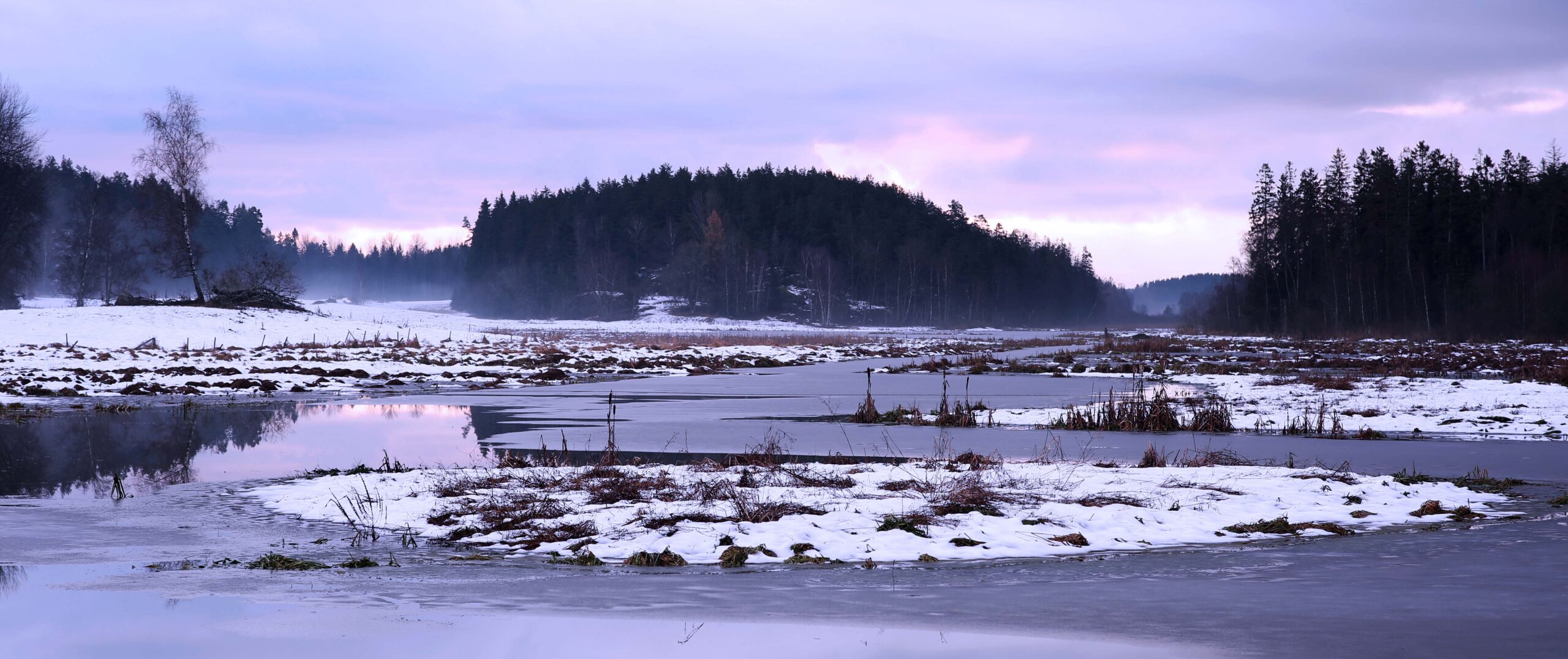
Wetlands are nature-based solutions that can reduce flood risks while improving water quality, photo Ekologigruppen
By translating ecosystem services into economic terms where robust valuation is possible, municipalities can incorporate a broader range of benefits into cost-benefit analyses, investment appraisals and long-term planning. The ambition should be to capture as many relevant ecosystem service values as possible, while recognising that current knowledge and methods do not yet allow all of them to be reliably quantified or monetised. Economic valuation therefore does not replace ecological or social arguments, but complements them by making more of nature’s benefits visible in financial and political decision-making.
As Tyrväinen emphasised during her presentation, economic valuation should be understood as a decision-support tool serving more comprehensive decision-making, not as an attempt to define the total value of nature.
Different benefits require different methods
One of the strongest messages from Luke’s work is that there is not only one way of valuing nature-based solutions. Different ecosystem services require different approaches.
Avoided-cost methods can estimate savings from reduced flooding or lower healthcare costs. Hedonic pricing analyses how access to green spaces affects property values. Carbon sequestration can be assessed using market prices, while benefit transfer methods allow municipalities to adapt results from existing studies when conducting local assessments is not feasible.
The choice of method depends entirely on the benefit being assessed, and every method comes with its own assumptions and uncertainties. Rather than producing one definitive number, economic valuation is about building the strongest possible evidence using the most appropriate methods available.
What does the evidence tell us?
Tyrväinen presented several examples showing how economic valuation is already supporting decision-making across Europe.
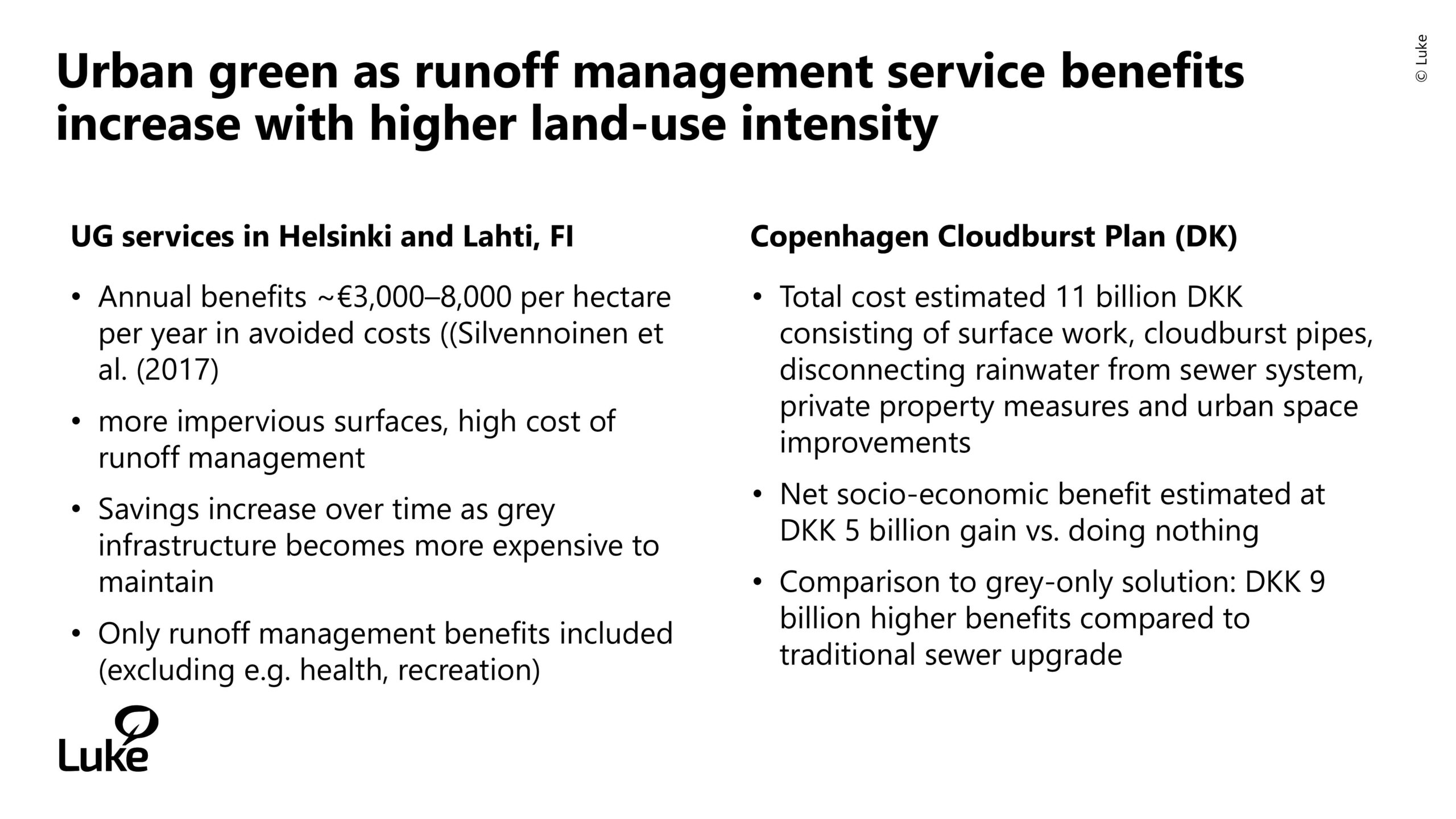
Economic assessments help compare alternative investments. Studies from Helsinki, Lahti and Copenhagen illustrate how avoided costs can be incorporated into planning decisions. (Source: Liisa Tyrväinen, EFUF 2026)
In Helsinki and Lahti, research has estimated that urban green infrastructure can generate annual avoided stormwater management costs of approximately €3,000–8,000 per hectare. These savings arise because vegetation and permeable surfaces reduce the need for expensive grey infrastructure.
Importantly, this figure only reflects one ecosystem service. It does not include benefits related to biodiversity, recreation, climate regulation or public health. Even relatively high estimates therefore represent only part of the overall value.
Another well-known example comes from Copenhagen’s Cloudburst Management Plan, where blue-green infrastructure was compared with expanding the conventional sewer system alone. The analysis estimated that the integrated approach would generate around DKK 9 billion more in socio-economic benefits than a traditional engineering solution, while also delivering multiple additional environmental and social benefits. Compared with taking no action, the project was estimated to produce a net socio-economic benefit of approximately DKK 5 billion.
Economic valuation is increasingly being applied to health as well. A study from Barcelona estimated that expanding urban green infrastructure could prevent more than 30,000 cases of poor mental health, reduce over 16,000 specialist mental health visits, and generate around €45 million in annual healthcare savings.
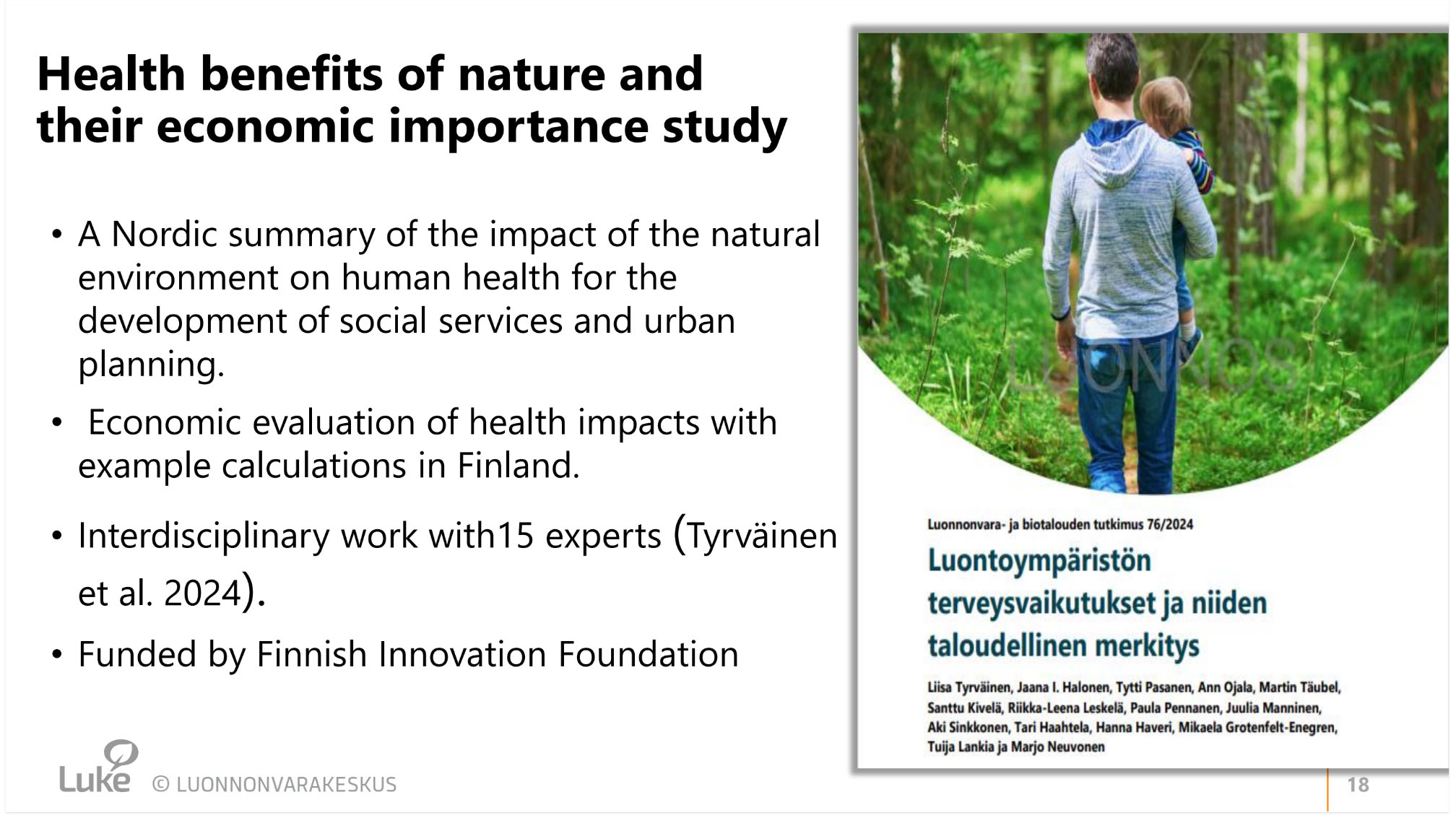
Health benefits are increasingly acknowledged in economic assessments, although the methods are still developing and involve considerable uncertainty. (Source: Liisa Tyrväinen, EFUF 2026)
Together, these examples illustrate how economic evidence can help communicate the broader societal value of investing in nature.
Numbers matter, but they should never stand alone
Perhaps the most valuable part of Tyrväinen’s presentation was not the impressive figures themselves, but the discussion about how they should be interpreted.
Economic valuations are highly sensitive to the assumptions behind them. Results can vary depending on the discount rate, the chosen time horizon, maintenance costs, local environmental conditions and, perhaps most importantly, which ecosystem services are actually included in the analysis.
Some benefits are relatively straightforward to quantify. Flood damage avoided, stormwater management and carbon storage often have well-established methods. Others remain somewhat harder. How should we value biodiversity? What is the monetary value of cultural heritage, sense of place or simply knowing that a species continues to exist? And how should municipalities account for benefits that may not become fully visible for decades?
These questions do not have simple answers.
Luke’s research also highlights that while the number of studies on nature-based solutions has grown rapidly over the past decade, comprehensive economic valuation studies are still relatively few. There are significant knowledge gaps, particularly around biodiversity, cultural ecosystem services and long-term health outcomes. Therofore, a critical interpretation is just as important as the numbers themselves.
From evidence to implementation
Economic valuation alone will not remove the barriers that municipalities face when implementing nature-based solutions. Institutional structures, fragmented budgets, political priorities and organisational silos all influence how decisions are made. A strong cost-benefit analysis does not automatically lead to investment. However, economic evidence can strengthen the conversation. It can help planners communicate across departments, demonstrate long-term societal benefits and broaden discussions beyond individual sectors. In this sense, valuation becomes not only concretizing the values of nature, but also about making invisible benefits visible. That perspective sits at the heart of Luke’s contribution to Nordlocal.
By reviewing existing evidence, developing practical approaches and identifying both the strengths and limitations of current valuation methods, the project aims to give municipalities better tools and more comprehensive data for making informed decisions. It is to ensure that the value nature creates, for climate resilience, health, biodiversity and quality of life, is recognised alongside other investments shaping tomorrow’s communities.

Meadows and nectar-rich plantings provide food and habitat for pollinating insects, which are essential for food production and healthy ecosystems, photo Ekologigruppen
 Stockholm
Här är våra tvärvetenskapliga tjänster
Med vidgade vyer, transparens och ett holistiskt tänkande driver vi projekt som skapar miljönytta för både kund och samhälle. I vår tvärvetenskapliga och omfångsrika tjänstepalett finns de evidensbaserade möjligheterna och lösningsfokuserade konsulterna.


